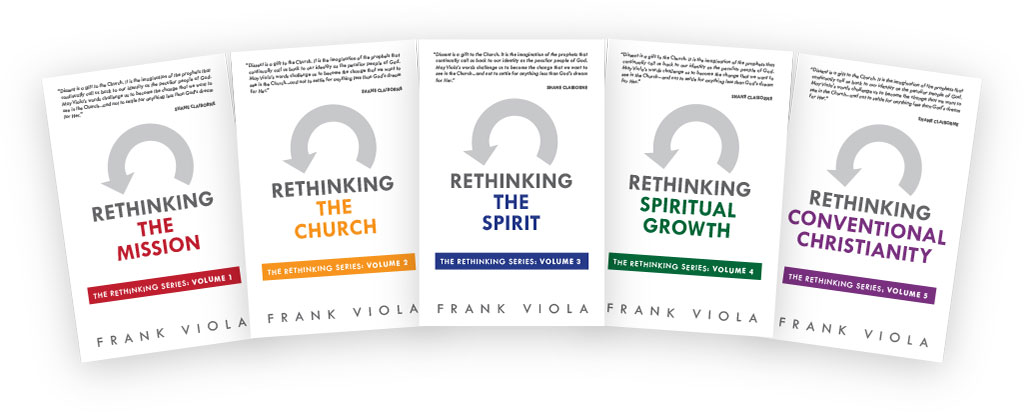
This blog post has been revised and turned into a chapter in The Rethinking Series.
The series includes each book in PDF, Kindle, and Nook formats.
Click here to view the Table of Contents for each book and how to get it

Frank Viola | Beyond Evangelical
Official Blog of Author & Speaker Frank Viola. Digging below the surface and moving beyond the shallows in today's Christianity.

This blog post has been revised and turned into a chapter in The Rethinking Series.
The series includes each book in PDF, Kindle, and Nook formats.
Click here to view the Table of Contents for each book and how to get it

 Sowing Seeds of Discord: Part II
I LOVED THIS! Its a huge part of my message of love =]
A very convicting post. Thanks for that spanking 🙂
Yes, I agree that it is always best to give the benefit of doubt to to the positive side whenever possible. When I look at the examples you give Frank, I see them as examples of gossip more than actually judging motives. I think there may be times when it is not wrong to judge a motive. By judge I do not mean condemn but to honestly examine the situation. For example, we all feel used and/or abused when we are taken advantage of. It seems to be built into us to sense when that is happening. In some cases it is our only hope of protection. I believe we are wise to make certain judgements. The problem comes when we then proceed to demean the other person and spread gossip about them. We must always view that person as someone in need of Gods grace, and love them as Christ does. If we honestly do this we will look beyond the motive to their need of the grace of God. With this in mind we will be better able to show them the love of Christ. (Maybe not complete but my thoughts so far)
Those are actually examples of judging motives, but they can be passed on via gossip. But whenever someone says “Ken said that or did that BECAUSE . . .” they are reading your heart intentions. And that’s impossible for a human being to know. Unless you tell me why you did something, I’m blowing bubbles to assume.
For instance, “Ken wrote this comment on Frank’s blog because Ken wants attention and he wants readers to think how articulate he is.”
See?
That’s a motive judgment and it’s sowing seeds of discord. The only case where saying what’s in a person’s heart is acceptable is when the Spirit of God supernaturally reveals this to a person. That’s a word of knowledge, an aspect of God’s omniscience revealed to a mortal. Peter and Simon the magician is an example. And what one does with that knowledge is another matter. They can use it for good or bad.
Oh, someone saying “God showed me” doesn’t make it so. And oftentimes that claim is unnecessary at best or harmful at worst as I point out in “Revise Us Again.” Other than that, it’s pure guesswork, and when it’s negative, it’s destructive as I’ve explained in the post. Again, only God can see into a person’s heart. Hope that helps.
I have found that this easily happens when we encounter circumstances in our lives where people make decisions that perhaps we don’t understand or want to agree with. Along with this and other type of instances it is so easy to look at it mathematically such as 1+1=2 it must, it must. But in reality in life situations with people 1+1 does not always =2. Especially, when that conclusion ends up demonizing another person and we are only suspecting with no factual meat.
This too is another area of maturity we are being called to. To allow our natural mind to be brought before the cross and put on that spiritual mind, Christ’s, which is born in love.
Yes assuming the best in people even if we think we know better is a good practice for many reasons but it helps to keep US pure too.
Love this series.
One thing I learned from some Jewish friends was the idea in Judaism of “judging favorably”–giving them the benefit of the doubt. I’ve tried to keep that in mind when I find myself jumping to a conclusion about what someone says or does.
Great post, Frank.
It’s always a good idea to try and speak well of the neighbor and put the best construction of what they do and say.
Not easy to do (because we are sinners who are often self-motivated). But a good thing to remember and a good way to live.
Happy Reformation Day to all.