

Rachel Held Evans kindly asked me to participate in her “Rally to Restore Unity.”
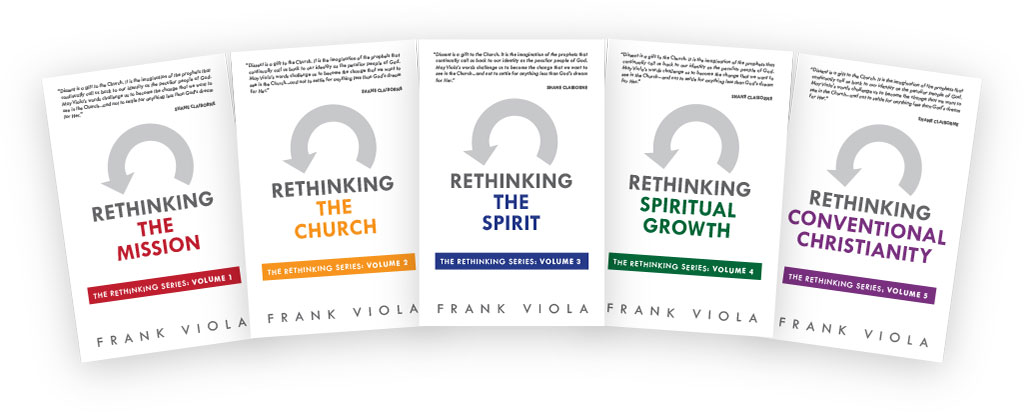
The blog post I wrote here (which was my contribution to Rachel’s request) has been revised and turned into a chapter in The Rethinking Series.
The series includes each book in PDF, Kindle, and Nook formats.
Click here to view the Table of Contents for each book and how to get it

 Revise Us Again: Endorsements
When we operate out of love, there is no elitism or separatism. Love thy neighbor as you love yourself.
Love was the hallmark of the early Christians. That is what they were known for, a love that sprang from an indwelling Lord. I wonder if I’ve ever fully experienced that wellspring.
You hear coaches say, “we gotta get back to the basics”. I am not a young man and when I look back over my life I always lost something when I left the intensity of the “basics”. The teachings and example of Christ are our basics.
I’ve lived a rebellious life, always questioning answers rather than answering questions, and nearing the twilight of my life I finally see the essential truly defining nature of our faith is found in the first principles. Love, and everything else will come together, everything else will make sense. Absolutely EVERYTHING.
Frank, love this post so much! It echoes my frustrations, thoughts and sadness at our “church system” today. This one verse keeps pounding in my head: (Jesus’ last prayer to ALL believers) “My prayer is not for them alone. I pray also for those who will believe in me through their message, that all of them may be ONE, Father, just as you are in me and I am in you. May they also be in us so that the world may believe that you have sent me” (John 17:20-21). Can you imagine Jesus looking down from the heavenly realm and seeing that currently we have approximately 38,000 denominations in the U.S.! We are a mass fragmentation of what Jesus plead to His Father that we’d be ONE. Sad. Blessings, Gaynor
“In essential, unity; in non-essentials, liberty; in all things, charity.”
How do you think we should define essential?
Personally I would think the only essentials should be the Trinity and the gospel.
Don’t you?.
But that raises the issue of false gospels.
I believe that true salvation only comes through trust, apart from any claim to worthiness of oneself, in the sacrificial death of Jesus of Nazareth for the forgiveness of sin
“by grace alone, through faith alone, in Christ alone.”
Would you agree?
Why or why not?
I don’t understanding what turning away means or exactly what role it plays.
I’m confused about that.
Please advise me.
Most Christians hold to the essentials being what’s in the Nicene and Apostle’s Creeds. Those are what most Christians have held most of the time (a la, C.S. Lewis’ view of the essentials). However, sometimes people are misinformed on say the Godhead. That doesn’t mean we cut them off, but we instruct them. See my post on the Creeds in the Archives for more.
Thanks for everyone’s contributions. They were very refreshing and reviving. I have been frustrated and upset for decades over disunity in the Church. I haven’t seen an emphasis on praying for unity or on the preaching of unity, even though it was emphasized by Jesus Christ. To me, the lack of unity in the Church can be a major reason to seriously doubt the validity of Christianity.
If we are to have unity without sound doctrine, then why is such a great importance placed on it in the scriptures. I am talking about pastors/teachers here. My bible says to flee from false teachings.
The question here is, what is sound doctrine? Any doctrine that detracts from Jesus Christ is not sound. But there are thousands of “doctrines” that don’t detract from Christ but that genuine Christians differ on. For example, someone can be an amillenialist, a postmillenialist. or a premillenalist and still be part of the faith. See my post on Getting Rid of Sectarianism Once and For ALL in the archives for more details on this subject. I say more about it there.
I just want to know if we can “draw” the line between the essential, non-essential, and all things” when it comes to maintaining or guarding the system of doctrines that we as evangelicals hold?
It’s walking on thin ice, I believe; it’s either your black or white, good or bad, biblical or not…
Evangelicals really don’t hold to a system of doctrine, but to 4 or 5 notes. See my post “Beyond Evangelical: Part I.” The answer is to your question is yes. And many evangelicals do. But not all.
I have to love this article. Please give me best advice: Should I post opposing views on a Christian Facebook Group? If I know they will not like what I will say… should I SAY NOTHING and leave them alone in dark? Or drop them some light?
Your decision. But what one person calls “light” another calls “darkness.” Since you’re asking my opinion, I’ll give it. Personally, I haven’t seen anything good come out of FB groups when it comes to disagreements, correction, divergent views expressed, etc. Just a lot of hurt feelings and a lot of bad blood. So speaking for myself, I would never try to persuade anyone about anything on a FB group. Blogs are much better for robust dialogue in my opinion. But your mileage may vary.
It’s tough when popular preachers like John Piper say that Arminian church members should not be excommunicated, but that anyone responsible for leading or teaching others in the church should.
This new calvinism has me shaking my head and make me worry that unity is becoming less and less of a possibility.
Frank do you believe in ecumenicalism?
Specifically explain/define what you mean exactly. That’s a term that has countless definitions and applications.
I love the imagery of the angels reviving the saints. I’ve often envisioned the shock and disbelief as well as the mass revelations of “oh…now I get it” accompanied by our utter humility and tears of regret (if tears existed in eternity).
It can be a difficult balancing act to be inclusive while also steadfast in Truth. When walking in our own power it is quite stressful, but when we rely on the Spirit of Christ then we can find peace as we surrender our uncertainties to His knowing.
I doubt we will be chided for the humble “I don’t knows” but most certainly we will be accountable for the “I was so sure!” Our best solution it seems would be to focus on our individual appointment before His throne.
Yes! C. Baxter Kruger calls this a big dose of “family embarrassment” … as in the dumb things done by family members that come up and everyone laughs about at family reunions. It is not shame … just a realization that we just didn’t get it — about whatever “it” was — or we acted or said something really dumb because we didn’t really think first. Specifically, he refers to our tendency to underestimate Jesus … to the extent that we try to “improve” on what Jesus said or did, because, um, Jesus didn’t quite get it right. LOL!
Great blog. Seeing this sort of thing coming from a multitude of sources. Hopefully, it is a move of God the Holy Spirit to restore Christ’s Body. One minor correction is the quote from Augustine was not authored by Augustine but by an irenic Lutheran named Peter Meiderlin.
That fact doesn’t alter the import of the saying. Praise the Lord.
Peace and Grace
H
Love the post Frank. It really takes a lot of commitment to work through the issues. It’s way to easy to walk away and write people off. So far, I havent’ found the people that are willing to stick it out but I’m glad you have/are.
You’ve done it again…you’ve echoed (put into clear words) what has been in my heart for so long. Humility that accompanies being “crucified with Christ,” followed by his “love shed abroad in our hearts by the Holy Spirit” and living by Jesus’ life. That’s the only way to move forward in unity and the knowledge of God.
Great post. What I would give to see what you learned in that year of dying/resurrection.
Laura: I tell the story in “Revise Us Again” – the chapter on “Stripping Down to Christ Alone” http://www.ptmin.org/books
*smelling salts* teeheehee that’s cute. Great article, the last paragraph..wow. So powerful! Love it all, as always.
“I have often said that sectarianism, elitism, and exclusiveness are like body odor. Everyone else can smell it except those who have it.” I love this…
Your recounting of that story is truly powerful. It’s a humble reminder of the power of the cross.
FROG
I think you nailed it quite well, Brother Frank. If Christians would just have a little patience with one another, and with the Lord as He works in people’s hearts, I think we would see some amazing resolutions to conflicts that would result in everyone growing in the Lord. Thanks for sharing!
Every time you share your experiences like this is an encouragement that it can happen…that it will happen…just still waiting to be in the midst of the “happening” 🙂
this is a great contribution to the unity theme. Steering clear of divisiveness is hard, especially when there are things we disagree about. Like you said, unity comes through a lot of dying to self. The only lasting way to have unity is to focus on Christ together. Once we are rooted and grounded in the love that is found in Him, we can talk about the things we disagree on without being divided because he holds us together.
I certainly have a lot of dying to do. My most recent blog post reflects what the Lord has been showing me in this area. It’s like I’m relearning the same lessons over and over again.
Spot on, Frank. When I look back at my life with Jesus, every single time I had built myself up with the feeling that I was serving God more faithfully than someone else, or that I understood Him better than another, it always ended up with a “horrible humbling”. There are things that my walk with God have taught me; there are infinitely more things that I can learn from others who also have walked with God (even if for a short time). The body of Christ will most glorify her Groom when He is Lord, and His voice from all quarters is valued.
Thank you so much for this contribution. I have personally been on both sides now. I have been in the unity by complete agreement camp. “How can two walk together unless they be agreed” was used in a twisted way to promote we must all agree on everything. This however did produce a completely sectarian elitist attitude and a feeling like we were highly favored of God since we have the truth. Now years separated from that and seeing it for what it was I see that it lacked life. Although we thought we had life we actually had a shell but inside no life. Now I am about 2 years into living in community life with a bunch of saints under the headship of Christ and have learned first hand that unity is by way of life. We are united together by an indwelling Lord (and trust me we are all from different backgrounds that could easily divide us.) This has proved to be what the scriptures bare out. The outer shell if you want to call it that, amongst us is love. Love that is longsufferring, unimposing and trusting in a Lord that is full and real. I don’t even know how to put to words the reality of the unity of the faith when Christ is the center and head.
I must point out one other thing that has been on my mind that goes a long with this. That is our identity, stance, foundation, etc.. must be the living person of Jesus Christ. Too many times it is instead biblical knowledge. And those who have strong biblical knowledge that are finding that as their source of strength, identity and foundation tend to display the attributes of the old man in relating to other christians that they don’t totally agree with. May Christ be our all in everything. By the way for those reading this I am not against bible knowledge I think it is very important. It just comes down to living out of Christ or out of self in this area. And it is easy to think we are so right and justify our un-Christlike behavior when proving it. Blessings.